
Key Factors When Selecting Hydraulic Tubing for High Pressure

Selecting hydraulic tubing significantly affects the safety, reliability, and efficiency of high-pressure hydraulic systems. Managers of plants, hydraulic systems engineers, and technical buyers must know the essentials of hydraulic tubing selection in order to save costs, reduce downtime, and improve system efficiency.
This guide covers what you need to know to make the right selection of tubing for high-pressure hydraulic systems in your operations.
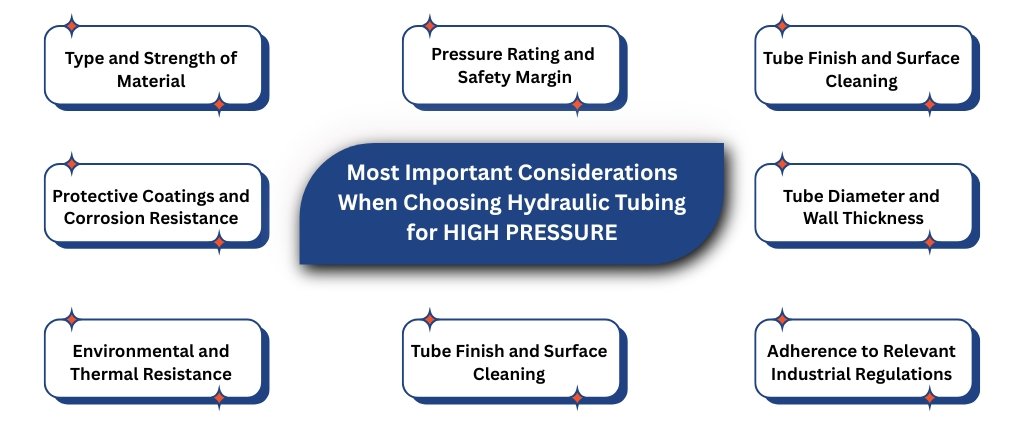
Most Important Considerations When Choosing Hydraulic Tubing for High Pressure
-
-
-
Type and Strength of Material
-
The tubing material needs to suit the requirements of your hydraulic system. Common materials include:
-
- Carbon Steel: Considered an industry standard for pressure applications of low to medium working pressure, this material offers a reasonable combination of strength, durability, and low cost.
- Stainless Steel: Provides the best high-pressure corrosion resistance, but is more expensive. Recommended for pressure applications that require sanitary or corrosion resistant.
-
Choosing the right material is critical for ensuring that you’re tubing can stand up to the operating pressure and the environment, avoiding early failures and expensive replacements.
-
-
-
Pressure Rating and Safety Margin
-
-
The tubing selected must have a pressure rating at least 25% higher than the maximum operating pressure of your system. This additional buffer helps protect your system from the dangers of unexpected pressure spikes and burst failures. Working close to the tube’s pressure limit increases risk and maintenance costs.
-
-
-
-
Tube Diameter and Wall Thickness
-
-
-
The inner diameter (ID) is a key factor in determining the flow rate of the fluid and the pressure drop. Correct sizing will ensure that the flow is not restricted, causing additional heat generation and a decrease in system effectiveness.
The thickness of the walls directly contributes to the tube’s ability to withstand pressure. Thicker walls will allow for greater pressure tolerances, but will also add weight and perhaps greater cost.
The balance between the tube’s diameter and the wall thickness helps determine the performance of the tube hydraulically while also keeping the tube durable and financially friendly.
-
-
-
-
Tube Finish and Surface Cleaning
-
-
-
The friction a tube continues the high flow becomes an issue. Contaminants trapped within the fluid and the tube can cause destructive wear as the materials flow and harsh wear the tube’s internals. Following the cleaning and tube absolute surface finish standards as described in the ISO and ASTM standards also preserves the durability of the seals. Smooth systems are the life of hydraulic systems.
-
-
-
-
Protective Coatings and Corrosion Resistance
-
-
-
Rapid corrosion of hydraulic tubing occurs in harsh environments with certain moisture, chemical, and extreme conditions. Tubes made with corrosion resistant alloys or with chrome used in composites fading with protective coating more recently, are also made in a way that needs less maintenance, corrosion control is also very tubing life prolonging. Systems are also more hydraulically demanding of conditions, as systems are more.
-
-
-
-
-
Accessibility and Flexibility
-
-
-
-
The pressure at which hydraulically tubing must operate is high. Tubing for at these pressure is as a rule very rigid maybe opposite, yet where Systems layout and installation Bounding circle, for within Flexibility that enough is pressure of High. Kinking, premature, and stress fractures are failing minimum bend radius for tubing. Planning installation well prolongs uptime and improves replicability of tubing.
-
-
-
-
-
-
Adherence to Relevant Industrial Regulations
-
-
-
-
-
Choosing tubing that meets or exceeds the international standards such as DIN, ASTM, JIS, and ISO to name a few or other relatively standard compliant, guarantees system performance, and quality with cohesion and safety.
Compliance with rigorous standards enables evaluation of material characteristics and the specific techniques of manufacture with respect to the metrics of reliability.
-
-
-
-
-
-
Environmental and Thermal Resistance
-
-
-
-
-
Hydraulic line tubing must perform with the reliability of the fluid temperature ranges and of the ambient outside temperatures. Tubing that is able to withstand temperature swings and ambient aggression without mechanical failure is able to devices function with a higher level of safety and have less operational down time.
The thoughtful selection of hydraulic tubing is the foundation for the construction of dependable, resilient, and effective hydraulic systems. To achieve optimum performance and assurance, partner with reputable suppliers and manufacturers who provide the best and most suitable components. Check out, for example, the exemplary products of reputable producers of hydraulic manifolds which provide superior design hydraulic components for the most demanding power systems.
Chơi slots nhận thưởng chỉ với 3 biểu tượng trở lên. 3D slots, video slots, megaway slots, jackpot lũy tiến,… tất cả các dòng game quay hũ kinh điển nhất hiện nay đều có tại 888slot login . Chúng tôi mang đến cho hội viên hơn 1.000+ vòng quay miễn phí với mức RTP cực cao. TONY12-11A