
One of the most common problems raised by maintenance is an ‘overheating’ power unit, particularly through the Coimbatore summer. You will notice a darkening oil, noisy pump, hard seals and reduced performance. Most of the time this problem isn’t due to a faulty pump but down to an undersized tank and incorrect cooling.
Basic Answer. To begin with, your tank size should be around 2-3x the pumps flow. Once you know the amount of heat being generated within your system, if it’s too much to dissipate via the tank walls, you will need a cooling system.The majority of mineral oils should be stored at between 40-55oC. Do not exceed 60oC. Referring to your oil supply data sheet will give you information on the specific oils you have.
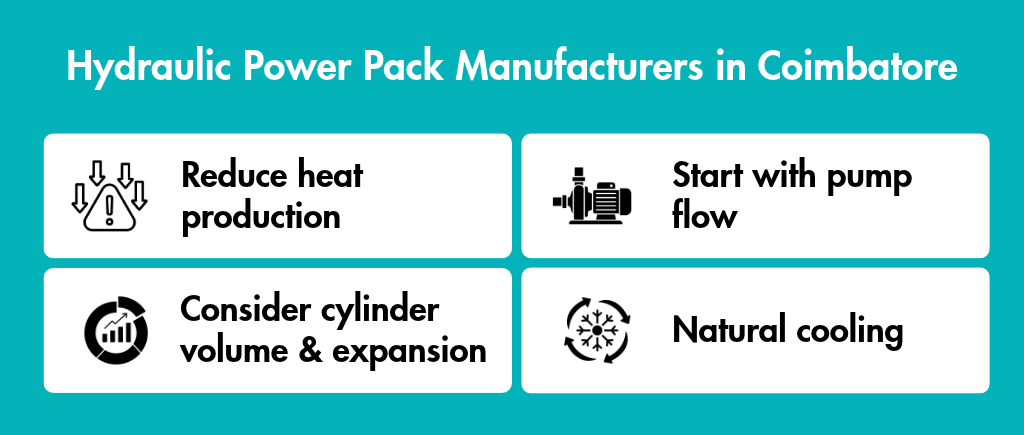
Key Points
- Tank should typically be sized to 2-3x the pump flow.
- Heat is wasted energy. Usually caused by throttling, overpressure dumping from the relief valve and internal pump leakage.
- Only enough to dissipate if running a low/intermittent duty cycle.
- Air Cooling – Generally suitable for most workshop environments. Water Cooling – Suitable for high temperature, dusty or small areas with access to clean water.
Reduce heat production.
Always give your manufacturers detailed information about the flow, pressure, duty cycle and ambient conditions.
Purpose of hydraulic tank?
Whilst most will assume it’s for storage, there are a few key functions of the tank. The tank stores the oil, provides a surface for heat dissipation, air bubbles can escape to the top of the tank and dirt/water can settle out before returning to the pump. It also provides compensation for the volume difference when extending and retracting the cylinder, due to the rod taking up space.
If the tank is too small all of these functions will suffer. The oil will circulate too quickly causing air to remain in the oil and temperature will increase.
How to Measure Your Hydraulic Tank
Start with pump flow.
A common starting point for industrial units would be to size the tank to 2-3x the pumps flow (in litres). So if the pump is 20lpm, we would suggest a tank around 40 to 60l. If high pressure and running continuously, you should go for the larger side.
| Pump flow | Tank at 2x | Tank at 3x |
| 10 L/min | 20 L | 30 L |
| 20 L/min | 40 L | 60 L |
| 40 L/min | 80 L | 120 L |
| 60 L/min | 120 L | 180 L |
Often compact packs can get away with less due to the short, intermittent strokes meaning the oil can cool between operations. Many of our compact AC & DC units (see Teutonic’s range) can have a smaller tank size as they have a 25l/35l tank option. However, as soon as they’re running continuously, the tank may no longer be suitable.
Consider cylinder volume and expansion.
You want the tank to be larger than what the pump requires. Calculate how much oil is leaving the tank when all the cylinders are fully extended and include expansion. Most designers will put around 80% of oil in the tank and leave the rest as air. Accumulators in the circuit will add more volume.
Correct Tank Details.
A good quality tank will often have:
- Baffles – between the inlet and outlet lines to prevent oil returning directly to the pump.
- Outlet – Positioned below the oil level to avoid foaming.
- Inclined Tank Bottom – With drain and clean out facility.
- Filler breather and sight glass with thermometer – to allow quick read by a technician.
Why Are Hydraulic Power Units Overheating?
All hydraulic systems will produce some heat. If you have a 15kW motor, which is 75% efficient, you’ll have around 3.75kW going into the oil. The question is can you dissipate this?
Typically overheating will be caused by:
- Overpressure Dumping – The pump is running at full flow through the relief valve which causes everything to become heat.
- Throttling – Flow control valves or undersized hoses will cause pressure drop but no useful work.
- Worn Pumps – Internal leakage causing heat and reduced output.
- Under-sized or crowded tank – Not enough surface area or dwell time.
- Poor Ventilation – Units are boxed into corners or covered in dust making it difficult to dissipate heat.
- Incorrect Oil Viscosity – Thick oil causes friction and thin oil causes more leakage.
What Causes Problems When Oil is Too Hot?
As the oil temperature increases, it will become thinner. This causes increased internal leakage on pumps and valves reducing efficiency and causing more heat. Seals will harden and become prone to cracking. Oxidation will also increase. A commonly cited rule of thumb is that for every 10°C rise, the oxidation rate will double. This means a unit running hot during the summer can cause much more frequent oil changes than expected. Varnish build up can cause sticking valve spools.
What Cooling is Suitable for My Power Unit?
| Method | Best for | Watch out for |
| Natural cooling (tank walls) | Light or intermittent duty, compact packs | Fails in continuous duty or hot rooms |
| Air-cooled oil cooler | General workshops and mobile equipment | Dust and lint blocking the fins |
| Water-cooled cooler | High heat loads, enclosed or hot spaces | Water quality, scaling, leak risk |
| Off-line (kidney loop) cooling | Large tanks, units that also need filtration | Extra pump, motor, and plumbing |
Natural Cooling.
Heat will be dissipated from the steel tank walls. If the tank is well ventilated and has a suitable size, this should be fine for low duty applications. Ensure the unit isn’t near walls, heaters or furnaces and has good air flow.
Air Cooled.
The most common option would be a finned radiator with fan. No water source is required and is easy to install. However, in dusty environments (Textile Shops, Foundries & Fabrication Shops) the fins will become blocked and require regular cleaning.
Water Cooled.
Shell and tube or plate cooler. Good for high heat loads and compact. Can be used if ambient temperatures are too high for an air cooler. Water source, scaling and risk of leakage.
Offline Cooling
A small pump will suck the oil out of the tank, run it through the cooler/filter and back into the tank.
How Can I Reduce Heat Generation?
- Cooling solutions will just treat the symptoms, however:
- Ensure the pump is sized to the correct flow.
- Relief valve shouldn’t be set higher than required.
- Long idle periods on machines should use unloading/load sensing.
- Hoses & fittings should be sized with reasonable velocities.
- Ensure clean oil is being used as dirty oil will cause wear on pumps and increased internal leakage.
- A small pump will circulate the oil from the tank, through the cooler/filter and back to the tank.
- Monitor the temperature using a gauge or thermometer throughout the entire shift.
What Should You Share Before Ordering a Power Unit?
The following information will be needed to determine the correct size for your tank and cooling:
- Maximum flow and working pressure.
- Duty cycle (continuous or short stroking with dwell time).
- Number of cylinders and sizes. How much oil is required.
- Ambient temperature and how well ventilated.
- Type of oil used & viscosity grade.
- Space available & Mounting Orientation.
- Preferred Cooling – Air or Water & Power Source Available.
How Can a Coimbatore Manufacturer Help?
By using a local manufacturer you reduce the design, testing & servicing loop. Teutonic Engineering have been based in Coimbatore since 2002 and manufacture bespoke hydraulic power packs tailored to the application. We also produce hydraulic cylinders, manifolds, pumps & valves. Our power units are used in a variety of applications such as Hydraulic Presses, Lifting Platforms, Injection Moulding Machines & Automation Systems. If you’re looking for hydraulic power pack suppliers in Coimbatore, having the cylinders, manifolds & power unit sourced from one place is very beneficial. This means the port sizes, pressures & mounting will all match from the start. If you’re looking for a hydraulic power pack manufacturer in Tamil Nadu who can also supply spare parts in future.
FAQs
Can I Just Use a Larger Tank?
Sometimes, if running low/intermittent duty. Increasing tank size means more surface area and dwell time. However, rarely will a tank alone be suitable for high pressure continuous duty.
What Temperature is Too High?
Many mineral oils should be kept below around 60°C to give the longest life, however this will depend on the oil grade and seal material. Refer to manufacturers data sheets.
Should I Use Air or Water Cooling?
Air cooled if the room is well ventilated. Water cooled if high heat loads, confined areas and clean water source.
Summary
Tank sizing and cooling are linked. By sizing your tank to 2-3x the pump flow you’ll have a good starting point. An honest assessment of your heat load will show whether you can use just a tank by itself. Duty cycle and environment will determine what cooling is suitable. Minimising heat generation is a cost effective option.
If you are designing a new unit or having issues with overheating, speak to hydraulic power pack manufacturers in Coimbatore. Simply get in touch with the team at Teutonic Engineering using the contact page and they can advise on a power pack designed for your application.