
Key Takeaways
- Quality cannot be inspected at the end of a process and defects cannot be caught by a final inspection.
- Material certificates, dimensional reports and records of pressure tests should be provided for each shipment.
- Welds and the surface of the rod are the two most common places for defects which can lead to field failures.
- The most common standard to define acceptance tests for hydraulic cylinders is ISO 10100.
- Price differences between suppliers is mostly due to the difference in materials, the depth of inspections and tests and the scope of the tests.
- Packing the cylinder for export is part of quality control. A cylinder that passes all the tests can still get damaged during transport.
What Are The Quality Inspection Stages In Hydraulic Cylinder Manufacturing?
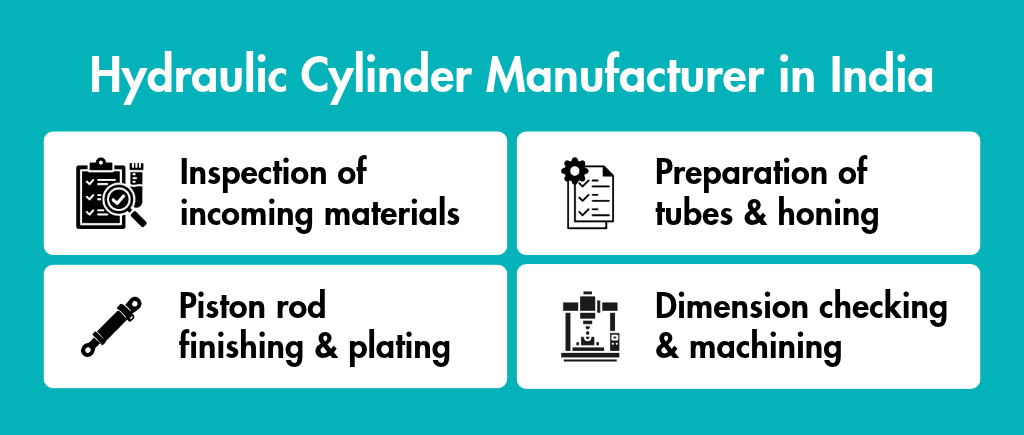
Hydraulic cylinder inspections typically comprise ten stages. They are: inspection of incoming materials, tube preparation, finishing of rod, welding inspection, machining inspection, check of seals and components, assembly, pressure testing and function, final inspection and export packing. Not all the suppliers document all the ten stages. We give details on what should be verified at each stage and what proofs the buyer should expect at each stage.
Inspection of incoming materials
Steel tubes, rods and bar as well as end caps/flanges are the raw materials for making a cylinder. Reliable suppliers inspect these materials prior to any cutting. This includes making sure that the raw materials ordered are in accordance with the purchase order, checking the dimensions and ensuring that the steel has no defective surface, cracks etc. Buyers can require additional assurance by requesting that the raw materials be manufactured in compliance with the requirements of EN 10204 3.1, in which case the raw material batch and test results are tied.
Preparation of tubes and honing
Piston seals are used to provide the required seal between the cylinder and the fluid in the system. The internal surface of the tube must be smooth and the bore should have the correct diameter to ensure the piston does not bind when moving. There are several tests carried out on the tube to verify if the bore has been honed to specifications and is smooth.
Piston rod finishing and plating
The rod is ground to achieve a smooth surface, and may be polished and plated with a hard chrome plate. The plate may be as thick as 0.008-0.012 inches. The hard chrome plate should be without cracks or voids. The plate is checked for thickness using X-rays. Some buyers specify a corrosion test, such as a salt spray test to ISO 9227, especially for cylinders to be shipped to humid or coastal areas. The test duration and the plate thickness come from the customer’s specification; the supplier should not set these.
Welding inspection
Welds in the joint between the end cap and the barrel of the cylinder carries the full pressure load, and therefore needs to be inspected. Visual inspection is the minimum requirement. For critical applications and/or for higher pressure service, buyers may request other tests such as dye penetrant or radiographic tests. For lower pressure service, designs which avoid the need for welding, such as tie-rod or bolted construction, may be preferred by buyers. For designs which are being compared, the trade-offs for using tie-rod construction versus welded construction is described in our note Welded versus Tie-Rod Construction.
Dimension Checking and Machining
The workpiece will have been machined to your drawing ready for final inspection. Critical dimensions are checked using gauges. For example thread depth. This is very important especially when exporting as your finished cylinder will need to fit into the clients machinery without having to adjust anything. It would be good to ask for a report on the dimensions taken.
Seals & Components Checked
Seals, wear rings, wipers and bushings are checked for the correct type, material and condition. It is good practice to check seal compound is compatible with the working fluid and temperature. Using an incorrect seal can cause damage to an otherwise good cylinder.
Clean
Contamination is a silent killer. Components are cleaned and ports sealed as soon as they are assembled.
Pressure & Function Testing
There are acceptance tests defined in ISO 10100 for hydraulic cylinders. This includes proof pressure, external leakage, piston leakage, friction and stroke. Proof pressure is typically around 1.5 times rated pressure. Ensure that the pressure used, time and outcome are noted.
Final Inspection & Marking
Before painting or packing the cylinder is visually inspected. The nameplate and marking is checked. Ports should be protected. Documentation and testing results are checked. The dimension report, material certificates and other documents are put together.
EXPORT PACKING
Packing is another quality area so can be included in your audit plan. Rods should be packed to avoid scratching and moisture. Ports should be plugged and cylinders packed to avoid movement. If cylinders are going internationally wooden pallets and crates must be compliant with ISPM 15. This is due to the International Standard for Phytosanitary Measures (Standard on Wood Packaging). This requires that the wooden packaging is treated to eliminate any live organisms that could cause any damage during the shipping process. Your freight forwarder may mention this.
Which Documents Should You Ask For Every Order?
As a minimum, you should require material certificates, a dimensional inspection report, and a pressure test record, as well as a packing list with marking details. For high-value orders, require weld inspection records, plating thickness records, and a corrosion test report. A good supplier will allow you to use a third-party agency to attend final inspection and witness test/measurement. Put this list in your purchase order. A requirement written into the purchase order is more enforceable than a request made at the end of the purchase order.
What Factors Should I Consider When Evaluating Hydraulic Cylinder Suppliers in India?
When reviewing hydraulic cylinder suppliers in India, you should look for evidence of a quality system, inspection records (written or electronic) and a commitment to provide them. An ISO 9001 certification shows they have a quality management system, but may not say anything about the thoroughness of their testing
The size of the supplier is not as important as the discipline of the process. A small shop with a clear, well documented system may be a better choice than a large shop with a less disciplined system. The same is true whether you are evaluating standard or industrial hydraulic cylinder suppliers.
What are the Main Parameters that Impact the Price of Hydraulic Cylinders in India?
The main parameters that affect the price of hydraulic cylinders in India are the bore and stroke, the rod diameter and the working pressure, the material grade and plating, if any, and surface treatment, cushioning and mounting, the type of seal, the depth of testing and inspection, and certifications required. If certified material tests and welds are required, the price will be higher.
A few other tips:
Be sure to provide the fluid, pressure and temperature in your enquiry to allow the suppliers to provide an accurate quote.
State your inspection and documentation requirements in the enquiry.
While negotiating the price of a product, the ex-works price (i.e. the price before packing and freight is added) is not the full cost. The total cost of the product, including packing and freight, should be calculated.
Quotes that are significantly lower than the rest should be scrutinized. Ask what was omitted from the quote.
What is Teutonic Engineering’s Approach to Inspection?
Teutonic Engineering has manufactured hydraulic cylinders in Coimbatore since 2002. Their product line includes bolted, industrial, tie rod, and welded cylinders as well as honed tubes, power packs and manifolds. The company is ISO 9001 certified and inspects each of its products throughout the various stages of the process from the sourcing of the material to the final product. Testing is done on the product prior to dispatch. Foreign customers can request inspection records, as well as other documents pertaining to their order, and discuss extra tests required as per their specification.
Frequently Asked Questions
What is the most important inspection stage for a hydraulic cylinder?
No stage is the most important, and a cylinder should be subjected to all three of the following to have a reasonable chance of catching defects that would otherwise show up in service: surface check of the rod, inspection of the welds (for welded designs), and a pressure test.
What standard covers acceptance tests for hydraulic cylinders?
ISO 10100 provides acceptance tests for hydraulic fluid power cylinders, and covers proof pressure and leakage tests as well as function tests.
What pressure is a hydraulic cylinder tested at?
Proof test pressure is approximately 1.5 times the rated working pressure, but in any case the pressure and standard should be in accordance with the customer’s specification.
Can a third-party inspector be sent by us to one of our manufactures in India?
Many buyers use independent inspection agencies to witness testing and final inspection. Arrange this in the purchase order.
How does one determine if a hydraulic cylinder supplier is reliable?
Reliability of a hydraulic cylinder supplier can be gauged based on the presence of a quality system certificate such as ISO 9001, sample inspection reports, and clear test records.
What documents should be attached to an export order?
The minimum documents should be a material certificate, a dimensional report, a pressure test record and a packing list. For critical orders, weld and plating records should also be provided.
What is the significance of export packing for hydraulic cylinders?
It is important to properly export pack cylinders because ports can collect dirt and rods can get scratched and corroded. Wooden dunnage and proper plugs will help maintain the condition of the cylinder during transit.
Conclusion
A hydraulic cylinder is as good as the worst stage of its manufacture. Buyers should be aware of the various stages of manufacture and final inspection to ensure the least amount of surprises and claims. When assessing Hydraulic Cylinder Manufacturers in India, judge them on processes and documents and their openness to Third Party Inspection and not on quotation price.
When exporting, send your drawing and specifications to our team via the contact page. Tell us which documents you need and we will confirm which will be provided and which can be added.