
Key Takeaways
Pressure ratings are a function of the overall design. Consideration of wall thicknesses between drilled passageways, the size of ports, and the layout of cavities is required to determine the design pressure.
Aluminum is the lightest weight material and the fastest to machine, and it is the material of choice for portable and transportable power units.
Ductile iron, a ferrous material, has good vibration damping, and is a good, economical choice for higher volume applications.
Machining and welding of steel is not as easy as Aluminum or Ductile Iron. For some applications, steel is the only choice due to the strength requirements.
Manufacturers need to disclose the peak pressure to the manifold block manufacturer to ensure the margin between design pressure and working pressure is adequate.
What Is a Manifold Block?
Manifold blocks are machined bodies where passages are drilled to route oil between devices to replace bulky and cumbersome pipe and hose fittings. It is usually part of a closed-circuit system, where the number of connections is less than the number of leak paths. A good design ensures a tidy and compact layout.
The choice of material affects the weight of the block, how easily it can be machined to desired tolerances, its resistance to corrosion and how it behaves at elevated temperatures. In general, the better the material, the more expensive it is.
What Decides The Right Manifold Block Material?
Pressure is the first factor. Look at the peaks, but more importantly, look at the normal working condition. Several circuits spike way above the relief pressure for a fraction of a second, and it’s those repeated spikes that eventually wear out a block. Next look at weight. A block on a mobile machine has a totally different set of requirements compared to a block on a press. Then look at the environment. Moisture, chemicals and salt air all change what is an acceptable material. How complex is the part and how many are ordered determine the price. A block made from a free-machining material is cheaper than one made from a hard material.
How Does Aluminum Perform As A Manifold Block Material?
Aluminum, most commonly alloy 6061-T6, is by far the most used block material for light and medium duty circuits. Many block manufacturers rate 6061 blocks at approximately 210 bar (3,000 psi) working pressure, and stronger alloys, such as 7075, are used when greater strength is required. It weighs approximately one-third that of steel, and machines and heats up less than steel. Corrosion and wear protection is provided with an anodize coating.
Of course there are limits. Fatigue and wear from repeated cycling is always a concern, as is the effect of a corrosive environment. For applications where repeated cycling is an issue, or the aluminum comes in contact with corrosive elements, then other materials may be a better choice. As mentioned previously, for numerous applications, these limits aren’t an issue.
What Makes Ductile Iron a Strong Middle Option?
Ductile iron is an option between steel and cast iron, typically ASTM A536 grade 65-45-12. It’s cast, not machined, from bar, and has typical ratings of 350 bar (5,000 psi). It is a more stable material than steel, and dampens noise and vibration better. It costs less than steel if a casting pattern justifies the volume.
Drawbacks include porosity, the need to test castings for it, a pattern cost for small runs, and a surface coating to prevent rust. It’s a relatively heavy material. Ductile iron is a good option for industrial power units and presses running at medium to high pressure.
When Is Steel the Right Choice for a Manifold Block?
Steel blocks, such as mild steel, EN8, EN19, or 4140 alloy, are the strongest and toughest options, especially when considering shock loads. Mild steel is a good choice when a manifold needs to be welded to a fabricated assembly. Stainless steel is a good choice when a manifold needs to be corrosion resistant, or when hygiene is a concern.
The extra strength of steel comes at the cost of increased weight and longer, deeper cycle times. Long, deep holes are hard to machine in steel. Tools wear out faster. Carbon steel also needs a surface treatment to prevent rust. Steel blocks are cut from bar, making them practical for low-volume runs.
How Do Aluminium, Ductile Iron, and Steel Compare?
| Property | Aluminium (6061-T6) | Ductile iron (65-45-12) | Steel (MS, EN8, alloy) |
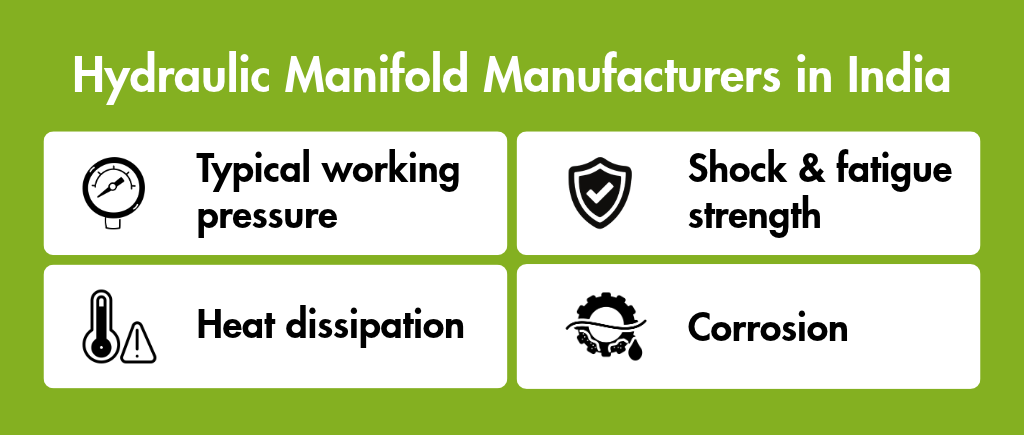
| Typical working pressure | Up to about 210 bar | Up to about 350 bar | Above 350 bar, by grade and design |
| Weight | Lightest, about one third of steel | Heavy, slightly under steel | Heavy |
| Shock and fatigue strength | Moderate | Good | Highest |
| Machining | Fastest | Good, stable | Slower, deep drilling is harder |
| Corrosion | Good, better when anodised | Needs coating | Needs coating, stainless is resistant |
| Heat dissipation | Best | Moderate | Moderate |
| Best fit | Mobile, portable, weight-sensitive | Industrial power units, vibration | High pressure, shock, welded, corrosive |
Choosing the Right Material for Your Needs
When designing a mobile generator or other type of machine that operates at or below approximately 200 bar, aluminum is usually the material of choice. It keeps the weight and the cost of the machine down. However, if the machine operates above approximately 250 bar, and is subject to constant high pressures for long periods of time, ductile iron or steel would be the better choice. For cost effective reasons, ductile iron becomes the material of choice if the volume of the order is high. If the volume of the order is low, or if the design is still subject to changes, steel from bar stock would be the better choice, because tooling wouldn’t be needed.
Stainless steel should be the choice if the machine is subjected to daily moisture, or if chemicals are present, or if the machine is subjected to washdowns.
A margin should always be left between the block’s pressure rating and the pressure relief setting. Also, the limits of the valves and the cartridges should be verified. A block is as strong as its weakest cavity.
Information To Supply Suppliers
Supply a schematic. Also include information about the max and min pressures, flow rate, medium and temperature range. The sub-plate and cartridge valve mountings and bores will affect the design. Typically, sub-plate valves are mounted using the ISO 4401 mounting. Cartridge valves all have standard bores. Then specify the thread type, number of ports, surface quality and testing along with documentation needs. A good supplier will undertake de-burring, polishing and pressure test a manifold. Request sight of the testing log.
How To Select Hydraulic Manifolds Suppliers in India
Whilst considering Indian hydraulic manifold suppliers, consider their CNC machine size, and the deepest hole they can accurately drill. Consider too how they manage version control for drawings and whether they provide material certification. Suppliers who can supply test logs and describe their polishing process are generally superior. Identical considerations apply to specialist and industrial hydraulic manifold suppliers. Again, a small sample order is often a more informative method of assessment than brochures.
Where Does Teutonic Engineering Stand?
Teutonic Engineering has operated in Coimbatore since 2002. They produce hydraulic cylinders, power packs and manifolds. hydraulic manifold manufacturer in india, they make mild steel and aluminium manifolds with a variety of schematics. Furthermore they can produce bespoke manifolds. Their in-house modular manifolds literature advises aluminium should be used for lightweight equipment and ductile iron or steel for high pressure applications – in-line with the guidance given above. As an Indian hydraulic manifold block manufacturer, they also produce the cylinder and power pack which are part of the identical schematic. If your application seems to require ductile iron then highlight this at an early stage so that a realistic assessment can be made of viability for your order size.
Concluding Remarks
With respect to materials, there is usually a compromise to be struck between pressure, weight, machinability and cost. Whilst considering a new schematic, enter pressure, flow and schematic information into our contact form and then talk through this with our team prior to finalising and drawing up the schematic. Also, analysing maximum pressures and the environment helps to avoid much subsequent re-working.
Frequently Asked Questions
What is the best material for a hydraulic manifold block?
It is a trade off between a number of factors like pressure, weight, environment and volume. Low to medium pressure work can be done by aluminum. For higher pressure work, ductile iron can be considered.
What pressure can aluminum manifold blocks take?
Blocks made from standard 6061-T6 alloy can take about 210 bar working pressure. Using a stronger alloy and careful design can increase this, but check with the manufacturer for your specific block.
Is ductile iron better than steel for manifolds?
Not always. As steel is stronger, more weldable, and more machineable, and manifolds made from it tend to be lighter. Ductile iron, on the other hand, is less expensive and better at damping vibration.
Why anodise aluminum manifold blocks?
Aluminum, being a softer metal, can benefit from anodizing to provide a hard, wear resistant, and corrosion resistant surface.
What pressure rating should I pick for a manifold block?
Pick a rating above your relief valve setting, expected pressure peaks, and agree on a safety margin with the designer, and then check the limits of the valve and cartridge.
What should I send you for a custom manifold quote?
The circuit diagram, working and peak pressures, flow, fluid, temperature, desired valve types, port threads, quantity, finish, tests and/or documents, and any other requests.
How do you test a manifold block?
There’s a dimensional check, a pressure check, a leak test, and a check for cleanliness after machining. You can ask for a test record.