
Overview
To achieve rapid approach, controlled pressure buildup and release, and reliable return cycles , High-tonnage hydraulic presses rely on controlled oil movement within the fluid power system . Flow demand, cylinder volume, pressure, response, installation arrangement, and other operating conditions should be assessed together to ensure consistent and efficient press performance.
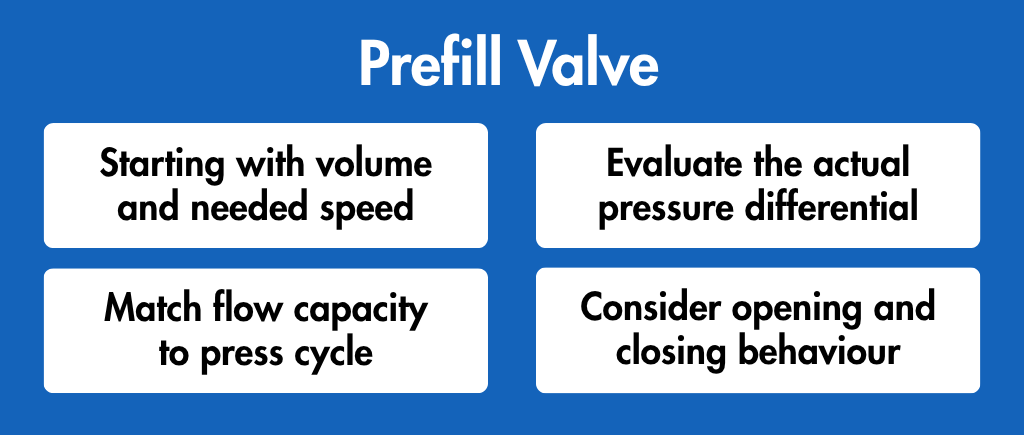
Starting With Volume and Needed Speed
The first step in the sizing process is to determine the volume of oil needed to move the primary ram at the desired approach speed. Oil flow requirements depend on the bore size and stroke of the ram as well as the target approach speed.
Large volumes of oil may be required to rapidly approach large rams. During actual pressing, the required flow rate may be relatively low.
Evaluate The Actual Pressure Differential
Effective flow capacity should be evaluated at the actual pressure differential and not be based solely on nominal port size. A suitable value should be selected from the manufacturer flow curves by balancing the calculated demand and the manufacturer’s flow curves, pressure ratings, and operating suggestions.
Match Flow Capacity to Press Cycle
A prefill valve is generally used to allow rapid filling and exhausting of a press ram chamber during low-pressure movement. The main hydraulic circuit of the press handles high-pressure movement.
For high tonnage equipment, the selected valve must support the required approach and return flow without creating excessive pressure drop. Flow restrictions caused by undersizing the valve may extend the cycle time and may cause excessive heating. Sizing the valve too large may result in high costs and large dimensions.
Consider Opening and Closing Behaviour
Valve response should be fast. The valve should open and close reliably. Pump pressure and flow pulsations will affect the stability of the valve and the noise level of the system, and ultimately the system’s reliability.
Engineers should examine pilot pressure, control method, gate opening and closing force, ram chamber and hydraulic circuit pressure inter-relationships.
Consider Pressure, Fluid, and Installation
Optimal design factors include the highest operating pressure, viscosity, oil temperature, fluid contaminant levels, sealing materials, and design orientation. Restrictions to flow through the port should be minimized with proper design. Undersized or overly long lines result in increased pressure drop throughout the circuit and poor response time, especially with high flow circuits.
Design for Ease of Maintenance
The design should incorporate ease of maintenance in the location of maintenance valves and accessibility. If valve access is overly time consuming, it increases production line down time especially on lower cycle presses.
Design Inspired by the Complete System
Ultimately, the design should be inspired by the entire system. Valve design is only one element of many circuits that should be considered in tandem with pump capacity, cylinder design, use of accumulators, hydraulic control valves, pressure settings, cycle time, and modern hydraulic system design that integrates modeling, monitoring, and control systems.
Committed to Achieving Reliability
Optimal prefill valve design considers flow rate, pressure rating, response characteristics, and fluid conditions along with the design cycle and service requirements. Teutonic Engineering manufactures hydraulic cylinders, power packs, and manifolds to support engineered hydraulic systems.