
The hydraulic sector is witnessing an unprecedented pace of transformative change that enables smarter, more sustainable, and more efficient systems. The transformation multiplies productivity across manufacturing sectors. The breakthrough technologies include AI-enabled pumps and sustainable hydraulic fluids. These hydraulic innovations are expected to reduce energy and maintenance costs to the tune of ₹8, 00,000 to ₹12, 00,000 annually, per mid-sized manufacturing facility.
The leading innovators of the respective sectors, industrial designers, equipment providers, and manufacturing executives, are to be updated on the leading innovations of the hydraulic sector for equipment design, functionality, and return on investment calculations for the year 2026 and thereafter. These innovations drive industrial productivity and efficiency.
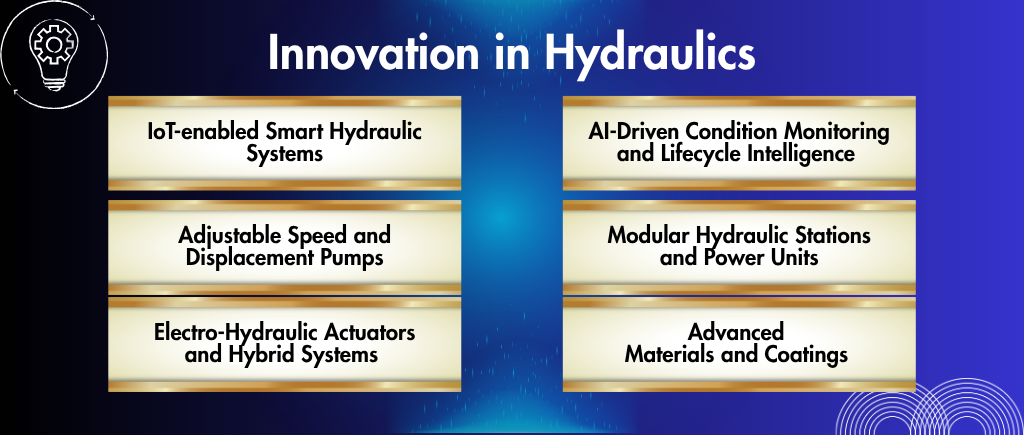
- IoT-enabled Smart Hydraulic Systems
Real-time Information: Today, hydraulic pumps and valves are embedded with Information and Communication Technology (ICT) that enables the monitoring of hydraulic systems for pressure, temperature, vibration, and volume flow.
Highlights of the Impact:
- Predictive maintenance can eliminate 70% of unplanned repairs
- Remote diagnostics can decrease service calls by 40%
- Automatic adjustment of pressure and volume flow can optimise energy consumption and reduce operational costs by ₹ 3, 00,000 to ₹ 5, 00,000 annually.
Expected to be standard in 2026 in heavy machinery, this technology is currently standard in automotive and aerospace.
- Adjustable Speed and Displacement Pumps
Demand-Based Control
These pumps eliminate the detrimental effects of running at full speed and wasting energy by adjusting their output to the load conditions.
Key Benefits:
- Compared to fixed-displacement pumps, energy usage can be reduced by 30-50%.
- For continuous-duty applications, ROI is expected in 18 months.
- Lower CO2 emissions, resulting in compliance with global regulations, enhance sustainability.
- Electro-Hydraulic Actuators and Hybrid Systems
Best of both worlds: electric precision and hydraulic force density. Perfect for robotics and other high-cycle automation.
Benefits:
- Ideal for space-constrained areas with a compact form factor
- Positioning with ±0.1mm precision is achievable
- Deceleration energy can be recovered
65% market adoption expected by end-2026 in automated manufacturing.
- Eco-Friendly Fluids vs Traditional Oil: Performance Comparison
Here are the key performance advantages of modern eco-friendly hydraulic fluids over traditional mineral oils, explained point-by-point:
Energy Efficiency Advantage Fluid
- Traditional Oil: Serves as the baseline standard with typical friction losses during operation.
- New Eco-Fluids: Deliver 15-20% better energy efficiency through superior lubricity that reduces internal system friction and pump strain.
Environmental Biodegradability:
- Traditional Oil: Poor natural breakdown, persisting in soil and water for years if leaks occur.
- New Eco-Fluids: Over 60% biodegrade within 28 days, dramatically reducing long-term environmental contamination risk.
Operating Temperature Range:
- Traditional Oil: Limited performance window of -20°C to 80°C, struggling in extreme hot or cold conditions.
- New Eco-Fluids: Expanded capability from -40°C to 120°C, ensuring reliable operation across diverse industrial environments.
Cost Savings Impact
- Conventional Oil: Fixed fluid replacement and maintenance costs.
- New Eco-Fluids: Positive impact of ₹2-4 lakh annual savings per system due to enhanced efficiency, extended fluid longevity, and diminished maintenance requirements.
- AI-Driven Condition Monitoring and Lifecycle Intelligence
Reactive to Predictive: Machine learning algorithms will analyse sensor data and determine potential failures weeks in advance.
Game-Changing Functionalities:
- Cloud fleet analytics across multiple machines
- Anomaly detection will identify concerns before human recognition
- Automated maintenance scheduling will decrease 50% of manpower.
- Modular Hydraulic Stations and Power Units
Plug-and-Play Flexibility: Pre- engineered modules expand easily for various uses.
Supplier Benefits:
- Quicker prototyping (weeks versus months)
- Simple adjustments without a complete system redesign
- Standardised parts reduce inventory costs
- Advanced Materials and Coatings
Friction Fighters: Nano coatings and composite materials decrease wear by 40% and energy loss by 10-15%.
Uses:
- Cylinder rods with self-lubrication
- Spools of valves with low friction
- Manifolds that resist corrosion in extreme environments
Geographic Trends Emerging in 2026
Post Current Technology:
- Wireless sensor networks that remove cables on mobile machinery
- Digital Twins for virtual testing of systems
- Seals that are compatible with hydrogen for integrating fuel cells
- 5G for remote control of dangerous zones
Roadmap for Strategic Implementation
Executives:
- Supplement the system with an analysis of energy waste to find the baseline
- Start testing smart pumps on the equipment with the highest run time
- Set a standard for the whole fleet with eco-fluid
- Develop a data structure for the analysis of IoT
Designer to Do List:
- Compatibility with adjustable speed
- Manifolds that are IoT-ready
- Patterns for modular mounting
- Choice of materials for eco-fluid
Immediate Decision Matrix
- High costs for energy – Consider variable speed pumps with smart monitoring.
- Frequent downtime – Consider predictive analytics with condition monitoring.
- Eco-sustainability objectives – Consider eco-fluids with electro-hydraulics.
- Assurance of design flexibility – Consider modular systems with adv
- anced materials.
Outstanding hydraulic performance can be achieved with innovative solutions from the Hydraulic Cylinder Manufacturer