
Have you ever wondered how forklift lifts so easily, factory presses move so exactly, or hydraulic lifts work so consistently? All of this is thanks to hydraulic power packs, which are a unit of hydraulic power systems. By understanding how hydraulic power packs work, engineers, students, and installers of hydraulic systems can troubleshoot, improve, and maintain systems on hydraulic equipment.
In this guide, I will break down the parts, systems, cycles, and use of hydraulic power systems step by step with the goal of helping you learn to use these systems from start to finish.
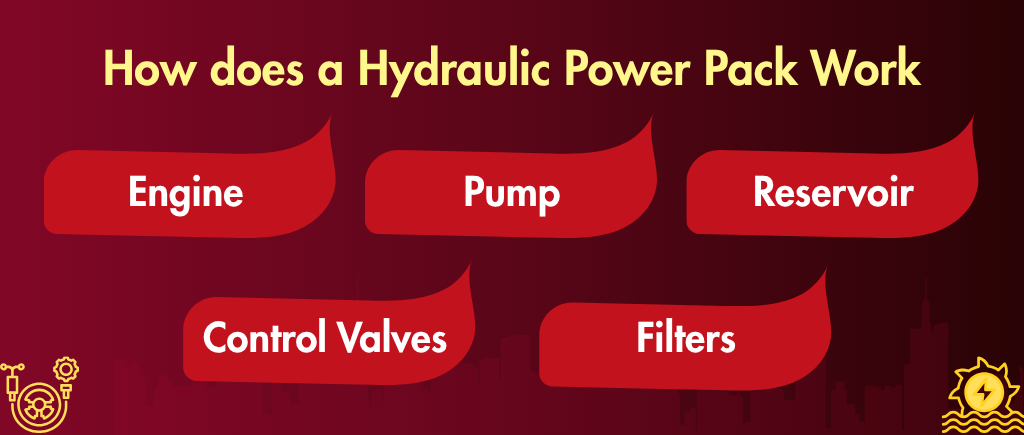
Important Parts of a Hydraulic Power Pack
- Engine – the starting point
Their purpose is to convert electric energy into mechanical energy in order to get the pump to move.
- Types of Motors: Automotive engines, standard AC induction, servo motors, and hydraulic motors (mobile equipment).
- Important Specs: Should match the requirements of the pump (HP/kW rating, RPM, and voltage).
Motors that are larger than the requirements are wasting energy, and motors that are smaller than the requirements will become overheated.
- Pump – Heart of the system
Purpose of the pump: change mechanical energy of the system to hydraulic energy, and this is done by moving (displacing) some amount of fluid, which creates pressure.
Main Types:
- Gear Pumps: They are cheaper. They are made for more than 3,000 gallons per minute, up to 200 bar.
- Piston Pumps: These are made for 400 bar and have variable displacement.
- Vane Pumps: These are made for medium pressure. They are made for medium flow and ultra-quiet.
- Reservoir (Oil Tank) – Fluid Headquarters
Important Functions:
- Thermal expansion: 2.5 – 3x (in the tank) system volume
- Heat dissipation (fins/baffles increase surface area)
- Air separation and settling of the contaminants
- The pump’s suction line pickup.
- Control Valves – Traffic Directors
Essential Types:
- Directional Control Valves (DCV): 4/2, 4/3 solenoid valves that route oil to the cylinders
- Pressure Relief Valves: Safety dump (set 10 – 20% above working pressure)
- Flow Control Valves: Needle/servo valves that control actuator speed
- Check Valves: Prevent backflow.
- Filters – System Lifesavers
- Suction Filter: Protects the pump (coarse 100 micron)
- Pressure Filter: Average 10 micron fine filter that protects valves and actuators
- Return Filter: Cleans oil before the reservoir (fine 25 micron)
Complete Operating Cycle: Step-by-Step
Phase 1: Start-up (Motor Energised)
- Electric motor rotates pump shaft (1450 RPM typ)
- Pump draws oil from the reservoir through the suction strainer
- Oil builds pressure (0 – working pressure in 2-5 seconds)
- Relief valve confirms safe pressure limit.
Phase 2: Work Cycle (Actuator Operation)
- Solenoid DCV shifts, and Oil is directed to the piston cap end.
- Rod end oil returns to the tank, and the piston extends.
- Control valve determines speed
- Load requirements confirmed by pressure sensor
Phase 3: Backstroke
- DCV moves to the rod-end port – cylinder retracts
- Return oil – filtered – reservoir
- Heat exchanger = 45-65°C = optimal
Phase 4: Standby / Shutdown
- DCV centres (all ports closed)
- The relief valve opens, and the pump is unloaded to the tank (low pressure)
- Motor is off or idling at low RPM
Typical Configurations and Uses
Compact Power Packs (Mini Presses, Forklifts)
- 2-10 HP, 20-50 LPM, 150-250 bar
- Tank-mounted pump/motor
- Single solenoid valve bank
Industrial Power Packs (Automation, Machine Tools)
- 15-50 HP, 50-200 LPM, 250-350 bar
- Separate motor/pump mounting
- Proportional / servo valve control
Mobile Power Packs (Trucks, Cranes)
- Engine or battery powered
- High IP67 protection class
- Priority flow for several circuits
Common Power Pack Problems and Solutions
- No Pressure:
- Motor rotation direction correct?
- Suction line restricted/clogged?
- Is the pump coupling sheared?
- Is the relief valve stuck open?
- Uncontrolled Operation:
- Air in the system (bleeding needed)
- Dirty blocked valves
- Pump wear (requires flow test)
- Electrical noises in the solenoid
- Overheating (>80°C):
- Reservoir is undersized
- High ambient temperature
- The heat exchanger is clogged
- Excessive relief valve bypass
New Functions in 2026 Power Packs
Clever Technology Upgrades:
- Variable Frequency Drives (VFDs) provide 30% energy savings.
- IoT Monitoring enables remote oversight of pressure/temperature/hours.
- With Auto-bleed valves, air purging is no longer required.
- Energy storage accumulators enable peak shaving.
Best Practices for Installation:
- Vibration isolation will be achieved with stable, level surfaces.
- For cooling, leave 1m clearance around the unit.
- Ensure no sharp bends in the suction line for a vertical line of <1m.
- Ensure local code compliance for electrical grounding.
- The unit must be pressure tested before commissioning.
Power Pack Mastery Checklist
Engineers/Trainees: Please print and bring to the field:
- Understand your pressure/flow requirements
- Ensure component ratings are consistent with the application
- Adhere to start-up/shutdown protocols completely
- Record baseline pressures and flows
- Change filters on schedule
Do you need reliable power solutions for your most demanding applications? Work with a Hydraulic Power Pack Manufacturer who designs and builds fully integrated systems for optimum performance.