
In modern industry, the ability to create regulated, huge force is what keeps things running. This is true for everything from huge textile factories to precision engineering centers in Coimbatore. Industrial hydraulic systems nearly always deliver this force.
An industrial hydraulic system is a way to move power by forcing an incompressible fluid (typically oil) through a sequence of parts to do mechanical work. When a machine needs to lift, press, or cut with thousands of pounds of power in a small space, hydraulics are the best choice. Gears and motors have their uses, but hydraulics are the best choice.
To understand how we “boost” pressure later in the blog, we must first look at the standard “ingredients” of these systems. A typical hydraulic setup relies on a Prime Mover, such as an electric motor, to drive the Hydraulic Pump, which converts mechanical energy into fluid flow. While the pump creates the movement of the oil, actual pressure only builds when that flow meets resistance within the system. Managing this power are the Control Valves, acting as the “brain” to direct fluid and regulate pressure levels. Finally, the Actuators, or cylinders, serve as the “muscles” of the machine, converting that stored fluid energy back into the linear motion required to move or lift heavy industrial loads.
A hydraulic intensifier is like a “pressure transformer.” It lets a machine take low-pressure fluid from a regular pump and change it into high-pressure fluid for tough jobs.
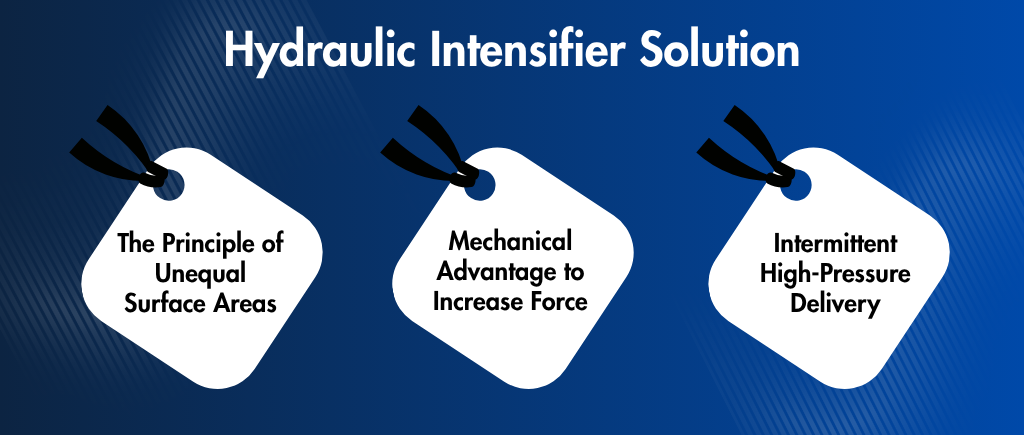
Main points on how it boosts pressure:
-
The Principle of Unequal Surface Areas
The secret to the intensifier lies in its internal design, which features two connected pistons of different sizes. A large piston receives the low-pressure fluid from the main pump, while a much smaller pistonpushes the fluid out. Because the same amount of force is applied to a much smaller surface area, the pressure is naturally multiplied. It works much like a person wearing high heels: all their weight/ force is concentrated on a tiny point, creating enough pressure to dent a floor.
-
Using Mechanical Advantage to Increase Force
Hydraulic systems work by using pressure to create greater force. When fluid moves through the system, it pushes a larger piston first, which then transfers the force to a smaller piston. Because the smaller piston has less surface area, the pressure becomes much stronger. This principle helps hydraulic machines lift heavy loads and perform powerful industrial operations with better efficiency.
3. Intermittent High-Pressure Delivery
Unlike a standard pump that provides a continuous flow, a hydraulic intensifier usually works in a “stroke” motion. It draws in the low-pressure fluid, intensifies it during the forward stroke to perform a high-energy task such as heavy-duty stamping, riveting, or operating a high-pressure press and then resets. This allows the industrial system to stay energy-efficient, using high pressure only when and where it is absolutely needed.
Achieving Power Through Precision
In modern manufacturing industries, efficiency plays a major role in maintaining smooth operations and avoiding costly delays. As discussed earlier, a hydraulic intensifier acts as an important solution for applications that require extra force and higher pressure during industrial processes. By using the concept of different surface areas, this pressure-boosting system helps industries generate powerful output without depending on expensive high-pressure pumps.
One of the biggest advantages of a hydraulic intensifier is its simple design and cost-effective performance. It delivers additional pressure only when required, making it highly useful for applications such as stamping, riveting, and pressing. At the same time, it helps the overall industrial system operate more efficiently while reducing unnecessary stress and wear on machinery.
For industries aiming to improve productivity and increase equipment lifespan, choosing the right hydraulic intensifier can be a smart long-term investment. With the right system in place, businesses can achieve better power, precision, and reliability for demanding industrial operations.